
Third Party vs White Label vs Private Label vs Loan License Manufacturing – Sharing Formulations Pvt Ltd
Understand the difference between Third Party, White Label, Private Label & Loan License Pharma Manufacturing in India – process, FDCA/CDSCO documentation & Form 51 explained by Sharing Formulations Pvt Ltd, a WHO-GMP & GLP certified manufacturer.
Third Party, White Label, Private Label & Loan License Manufacturing: A Complete Guide by Sharing Formulations Pvt Ltd
Choosing the right manufacturing model is one of the most important decisions a pharma brand, distributor, or entrepreneur will make. Terms like Third Party Manufacturing, White Label Manufacturing, Private Label Manufacturing, and Loan License Manufacturing are often used interchangeably — but each follows a distinct business structure, regulatory pathway, and documentation process under India's drug laws.
Sharing Formulations Pvt Ltd is a WHO-GMP and GLP certified pharmaceutical manufacturing company, working with pharma marketing companies, startups, and franchise businesses across India to produce quality-assured formulations under Third Party, White Label, Private Label, and Loan License arrangements. Our certified infrastructure and in-house quality control laboratory mean every batch is manufactured and tested to the same rigorous standards, while we guide partners through FDCA and CDSCO compliance from start to finish. This guide breaks down each model in plain language, along with the process, required documents, and the role of Form 51 in getting product permission.
--------------------------------------------------------------------------------------------------------------------------------------------------------------------------------------------
1. What is Third Party Manufacturing?
Third Party Manufacturing (also called contract manufacturing) is an arrangement where a pharma company (the 'marketing company') outsources production to an already-licensed manufacturer, like Sharing Formulations Pvt Ltd, instead of setting up its own plant.
Key features:
- The marketing company supplies the formula, specifications, and branding requirements; the manufacturer handles production, quality control, and packing.
- The manufacturer holds its own valid drug manufacturing license (Form 25 / Form 28) and is fully responsible for GMP compliance at its site.
- Products are sold under the marketing company's brand name.
- Ideal for companies that want flexibility, custom formulations, and low capital investment.
2. What is White Label Manufacturing?
White Label Manufacturing is a model where the manufacturer already has a ready, approved formulation in production. A brand simply 'labels' this existing product with its own name, logo, and packaging — with little to no formulation customization.
Key features:
- Fastest route to market since the product formula, testing, and approvals already exist.
- Multiple brands may sell the same base formulation under different labels.
- Lower cost and shorter lead time compared to a fully customized product.
- Best suited for businesses wanting to launch quickly without investing in R&D.
3. What is Private Label Manufacturing?
Private Label Manufacturing sits between white labelling and full custom development. The manufacturer produces the product largely to the brand's own specifications — pack size, flavour, colour, dosage strength, or packaging design — but usually for that one brand/client exclusively.
Key features:
- Greater customization than white label, but generally less than a fully bespoke third-party formulation.
- The formulation may be exclusive or semi-exclusive to the brand ordering it.
- Popular for building a distinct, differentiated product range under one's own identity.
4. What is Loan License Manufacturing?
A Loan License is a specific legal category recognized under the Drugs and Cosmetics Rules, 1945 (Rule 69A). It allows an applicant who does not own manufacturing premises to 'borrow' the manufacturing facility, plant, and machinery of an already-licensed manufacturer, and hold a drug manufacturing license in their own name for that borrowed facility.
Key features:
- The applicant (loan licensee) becomes the actual license holder — not just a brand owner buying finished goods.
- The host manufacturer (facility owner) provides the premises, equipment, and technical staff.
- Regulatory responsibility is shared, but the loan licensee is legally accountable as the license holder for the products manufactured.
- Requires a formal loan license application to the State Licensing Authority, separate from a simple third-party manufacturing agreement.
--------------------------------------------------------------------------------------------------------------------------------------------------------------------------------------------------------------------
Regulatory Framework: FDCA and CDSCO
Pharmaceutical manufacturing in India, in every model above, is governed by the Drugs and Cosmetics Act, 1940 and Drugs and Cosmetics Rules, 1945, administered at two levels:
- State FDCA (Food and Drugs Control Administration): Grants and monitors manufacturing licenses (Form 25/28, Form 25A/28A for loan licenses), conducts facility inspections, and handles most formulation-level approvals for the state where the manufacturing unit is located.
- CDSCO (Central Drugs Standard Control Organisation): The central regulator responsible for new drug approvals, Schedule X and biological products, import/export regulation, clinical trials, and overall drug policy — working alongside state authorities through the Central Licensing Authority for specified categories.
Regardless of the model chosen, the actual manufacturing unit must hold a valid GMP-compliant license, and any brand name used must be cleared through the Form 51 undertaking described below.
--------------------------------------------------------------------------------------------------------------------------------------------------------------------------------------------------------------------
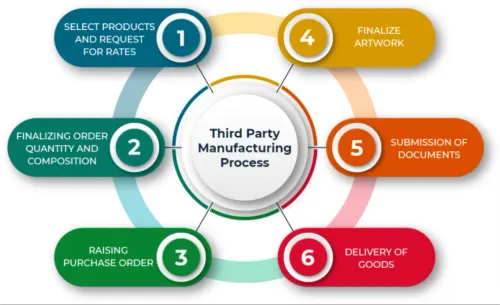
Process for Third Party / Private Label / White Label / Loan License Manufacturing
Step 1 — Manufacturer Selection & Product Finalisation Identify a licensed, GMP-compliant manufacturer with the right dosage-form capability. Finalise the formulation, dosage form, and packaging.
Step 2 — Agreement Execution Sign a manufacturing/loan license agreement clearly defining responsibilities, quality standards, pricing, and compliance obligations between both parties.
Step 3 — Brand Name Clearance (Form 51) Before applying for product permission, an undertaking in Form 51 must be submitted confirming the proposed brand/trade name is not already in use and is not misleading (explained in detail below).
Step 4 — Application to the Licensing Authority
- For a standard manufacturing license: Form 24 (non-biological) or Form 27 (biological) is filed with the State FDCA.
- For a Loan License specifically: Form 24A / Form 27A is filed by the loan licensee, along with the Form 51 undertaking, agreement with the host manufacturer, and supporting technical documents.
Step 5 — Document Scrutiny & Site Inspection The licensing authority reviews the application, the Site Master File, and technical staff qualifications, then conducts a physical inspection of the manufacturing premises.
Step 6 — Grant of License / Product Permission On satisfactory review, the license is granted:
- Form 25 / Form 28 — Manufacturing license (own facility)
- Form 25A / Form 28A — Loan license (borrowed facility)
Step 7 — Test License (if applicable) For new formulations or combinations requiring trial batches or stability data before commercial approval, a Test License (Form 29) may be issued to permit limited-quantity manufacture for testing purposes.
Step 8 — Commercial Manufacturing & Compliance Once approved, commercial production, labelling (per Schedule H/H1/X requirements where applicable), and dispatch can begin, subject to ongoing GMP compliance and periodic inspections.
--------------------------------------------------------------------------------------------------------------------------------------------------------------------------------------------------------------------
Documents Required (FDCA / CDSCO Compliance)
A. Corporate & Identity Documents
- Certificate of Incorporation / Partnership Deed / MOA & AOA
- PAN Card and GST Registration of the company
- Aadhaar Card and PAN Card of directors/partners/authorised signatory
- Company profile
- Wholesale Drug License (Form 20B for non-Schedule C/C1/X drugs, Form 21B for Schedule C/C1 drugs)
B. Manufacturing & Facility Documents
- Valid drug manufacturing license of the manufacturer (Form 25/28) or host facility
- WHO-GMP / Schedule M compliance certificate
- Site Master File (layout, equipment list, utilities)
- Technical staff details (qualifications of the Competent Person, Production Chemist, Quality Control staff)
- Drawing/plan of manufacturing premises
- Title deed or notarised rent/lease deed of the premises
C. Product & Agreement Documents
- Manufacturing/Loan License Agreement between the brand and manufacturer
- Master Formula Record and manufacturing process details
- Product specifications, testing methods, and stability data
- Packing details and artwork
- Form 51 undertaking for the proposed brand/trade name
- Non-Disclosure Agreement (NDA), where the formulation is proprietary
D. Application Forms
- Form 24 / 24A (manufacturing license application – non-biological drugs)
- Form 27 / 27A (manufacturing license application – biological drugs)
- Form 29 (test license, where required)
- Cover letter to the licensing authority outlining the application
E. Optional but Recommended
- Trademark application/registration certificate for the brand name
- Free Sale Certificate / COPP (for products intended for export)
- Power of Attorney (if a regulatory consultant is filing on the applicant's behalf)
--------------------------------------------------------------------------------------------------------------------------------------------------------------------------------------------------------------------
Form 51: Description and Purpose
Form 51 is a statutory undertaking required under the Drugs and Cosmetics Rules whenever an applicant intends to market a drug under a brand name or trade name. It must be submitted to the licensing authority along with the product permission/manufacturing license application.
What Form 51 confirms:
- To the best of the applicant's knowledge, the proposed brand name or trade name is not already in existence for any similar drug in the country.
- The proposed name is not deceptively similar to an existing brand and will not mislead consumers, prescribers, or pharmacists — for instance, by falsely implying a particular composition, strength, or therapeutic claim.
- The applicant takes responsibility for the name being used in good faith and in compliance with labelling and advertising regulations.
Why it matters: Form 51 acts as a safeguard against brand-name conflicts and consumer confusion in the pharmaceutical market. Without this undertaking, the licensing authority will not process product permission for a branded formulation — making it a mandatory step in Third Party, White Label, Private Label, and Loan License Manufacturing alike, wherever a new brand name is being introduced.
--------------------------------------------------------------------------------------------------------------------------------------------------------------------------------------------------------------------
Why Partner with Sharing Formulations Pvt Ltd
Sharing Formulations Pvt Ltd is a specialised, WHO-GMP and GLP certified manufacturer, focused exclusively on Mouthwash, Antiseptic Solutions (including Povidone Iodine), and Disinfectants. This focused expertise means every formulation we produce benefits from deep category knowledge, dedicated production lines, and quality systems built specifically around these product categories — whether you're looking for Third Party Manufacturing, White Label products ready to launch, a Private Label range built to your specifications, or support structuring a Loan License arrangement.
Partnering with us gives you:
- WHO-GMP and GLP certified manufacturing infrastructure dedicated to mouthwash, antiseptic, and disinfectant formulations
- An in-house, GLP-certified quality control and testing laboratory for reliable, consistent batch quality
- End-to-end documentation support for FDCA and CDSCO approvals, including Form 51 filing
- Experienced regulatory and quality teams to manage inspections and compliance
- Transparent agreements and timelines from formulation to product launch
Ready to launch your own mouthwash, antiseptic, or disinfectant brand? Get in touch with our team to discuss the right manufacturing model for your business.
third party manufacturing, white label pharma manufacturing, private label manufacturing, loan license manufacturing, FDCA documents, CDSCO drug license, Form 51 drug license